Background
Modern residential construction has shifted toward highly airtight homes for energy efficiency. This creates oxygen-limited conditions when a fire occurs. Unlike the well-ventilated fires that historical fire codes and research were built around, these under-ventilated fires burn slower and produce significantly more toxic combustion byproducts, posing new hazards that existing tools are not designed to handle. A key challenge in studying these fires is that the most informative physical signal, the mass loss rate (MLR), whose peak marks the precise transition from well-ventilated to under-ventilated combustion, cannot be measured in a real fire. While gas sensors (CO, O₂, NO₂, NH₃, CH₄, VOCs) can be deployed in practice, regime transitions are difficult to identify directly from raw sensor signals because the relevant combustion behavior is embedded within a complex high-dimensional sensor space.
A Framework for High-Dimensional Fire Sensor Data Analysis
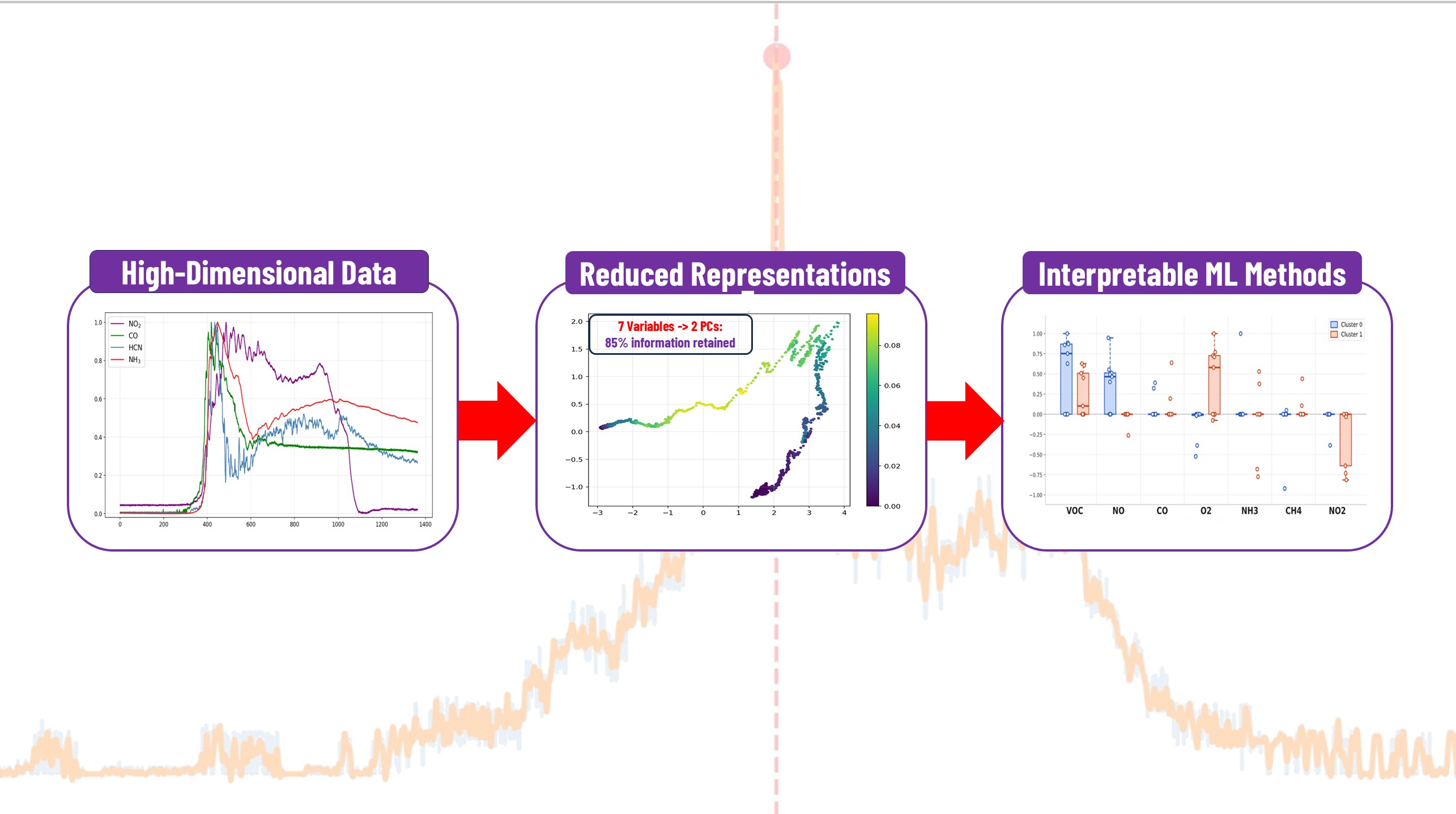
Large-scale fire experiments generate hundreds of simultaneous sensor measurements that are difficult to interpret using conventional analysis. We developed a three-step framework (Initial Screening and Visualization, Time Segmentation, and Targeted Sensor Correlation Analysis) to extract physically meaningful structure from this high-dimensional data. We used PCA to compress 10 sensor measurements into two dimensions retaining 89% of total variance and identified a faulty CO₂ sensor that had exceeded its operational range. Next, k-means clustering identified three distinct fire regimes with the boundaries aligning precisely with the well-ventilated to under-ventilated transition. Sparse regression models were leveraged within each regime to achieve R² values of 0.96, 0.90, and 0.91, compared to 0.59 for a single global model. This demonstrates that accounting for fire regime structure is essential for accurate and interpretable sensor-based characterization.
Machine Learning methods for Combustion and Decay Analysis

Building on the PCA → K-means → sparse PLS framework we developed for fire regime characterization, we extended the methodology from a single experimental fire test to the complete experimental dataset through the development of an object-oriented programming (OOP) framework that automates preprocessing, clustering, sparse regression, and visualization across all experiments. We also developed a method for comparing fire regimes, enabling direct comparison of regime behavior through the underlying chemical relationships identified by the framework. In parallel, we explored machine learning approaches for fire regime transition detection using deployable gas sensor data, with potential applications in fire modeling, sensing technologies, and operational decision-making for fire responders.